
Ferrari F355: Everything You Need To Know
Written by Scott Newman
Ferrari has been on a relentless upward trajectory for decades now, making it the world’s most profitable car company and one of the world’s most recognisable brands. If you had to pinpoint the moment when this trajectory began, it would be mid-1994 with the release of the Ferrari F355.
The years following founder Enzo Ferrari’s death had been turbulent. Ferrari’s new F40 supercar was a smash hit, but its flagship V12s were aging and its Formula 1 team not only struggled to match the dominant McLaren but had been overtaken in competitiveness by Benetton and Williams.
Worst of all, the one new member of Ferrari’s range, the mid-engined V8 348, was poorly received. Former Scuderia Ferrari Sporting Director, Luca di Montezemolo, bought himself one following a successful stint as manager of the organising committee of the 1990 FIA World Cup and described it as “terrible” and “a s*** car”.
Having been installed as Ferrari president by Fiat chairman Gianni Agnelli in November 1991, di Montezemolo now had the power to rectify this.
What followed was one of the most substantial revisions of any modern automobile. That might sound like hyperbole, especially as the F355 is stylistically clearly a derivation of its 348 predecessor, but to put the improvement in perspective, the new car was more than FIVE SECONDS quicker around Ferrari’s Fiorano test track.
Originally, the plan was to give the 348 a mild facelift, but di Montezemolo’s arrival, as well as the release of the groundbreaking Honda NSX, led to a radical overhaul that not only improved performance but comfort, useability and quality.
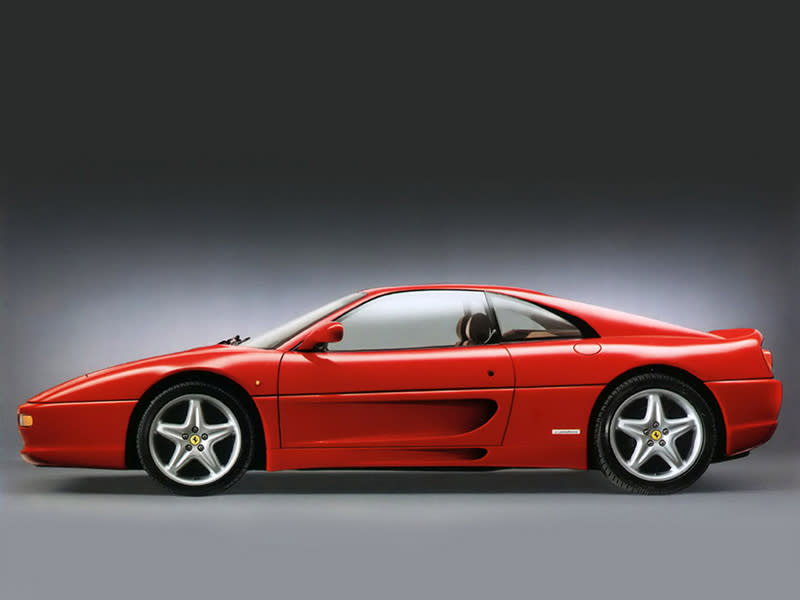


Pininfarina changed every exterior surface bar the roof, glass and front guards, eliminating the side strakes that linked the 348 to the 1980s but reintroducing the quad taillights that had been a feature of the prior 308 and 328. Style is subjective, but it’s a dissenting voice that calls the F355 anything other than beautiful.
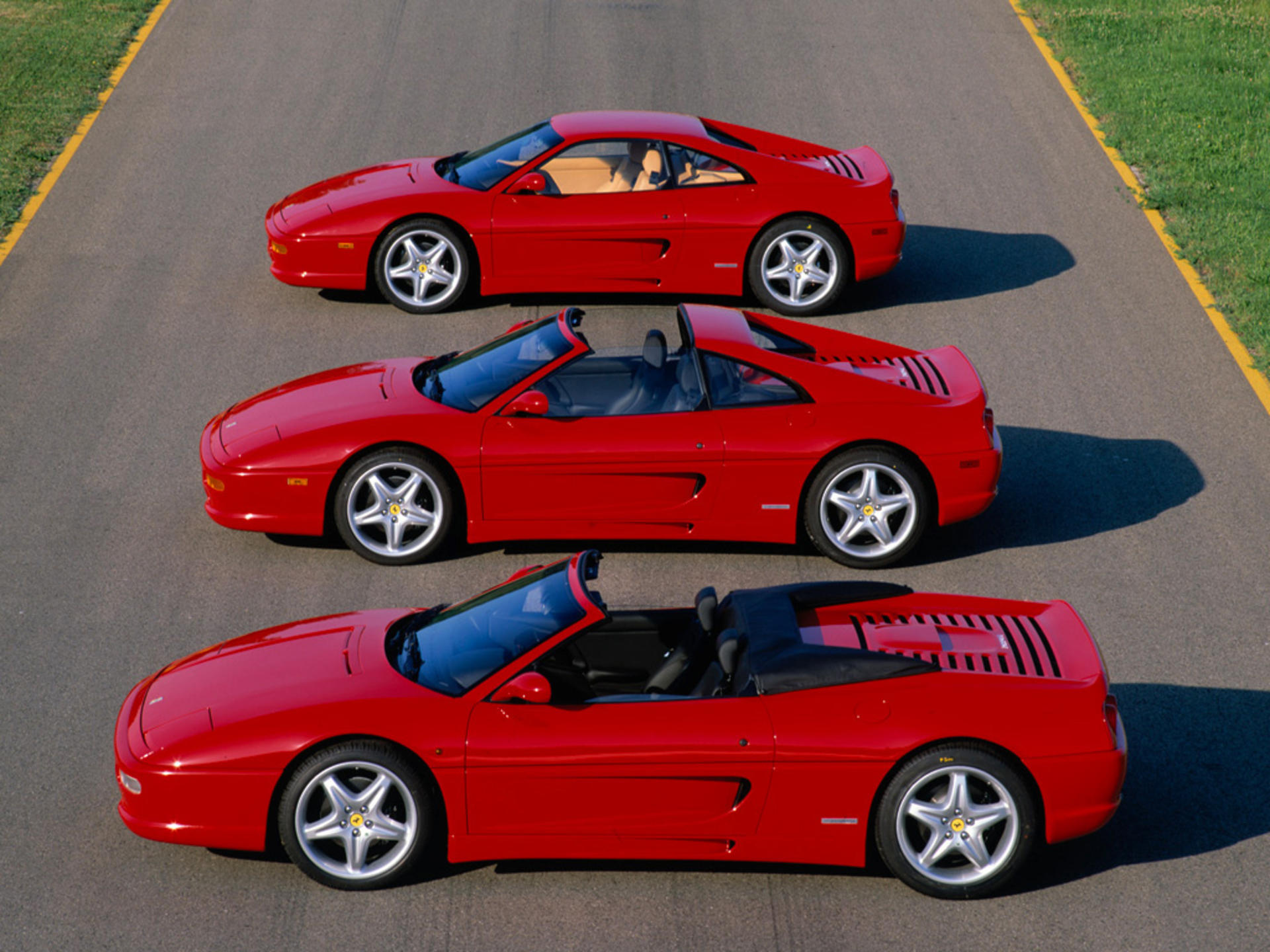
A Berlinetta coupe and targa-top GTS were available from launch, a drop-top Spider joining the range a year later due to the fact the 348 Spider had only been released relatively recently.
The interior received an overhaul, especially in terms of quality – the exterior mirror controls, for instance, were sourced from Audi. A beautifully slim three-spoke steering wheel would sadly make way for a much more bulbous airbag-equipped unit in 1996, but the bucket seats had greater support and the pedals were drilled aluminium.


It wasn’t just a pretty face, either, the body spending 1300 hours in the wind tunnel, the flat floor having a channel that was fed air from the nose to help it slip through the air.
A 2mm increase in stroke enlarged the V8 from 3405cc to 3496cc, but the changes went far deeper than that. The F129B featured a new five-valve head with three inlet and two exhaust valves for each cylinder, along with titanium con-rods and forged pistons which allowed for an 8500rpm redline and 8800rpm limiter.
An 11:1 compression ratio, controlled by Bosch Motronic 2.7 – later Motronic 5.2 – resulted in 280kW at 8250rpm and 363Nm at 6000rpm, enormous gains over the 220kW at 7200rpm and 334Nm at 4200rpm offered by the 348.
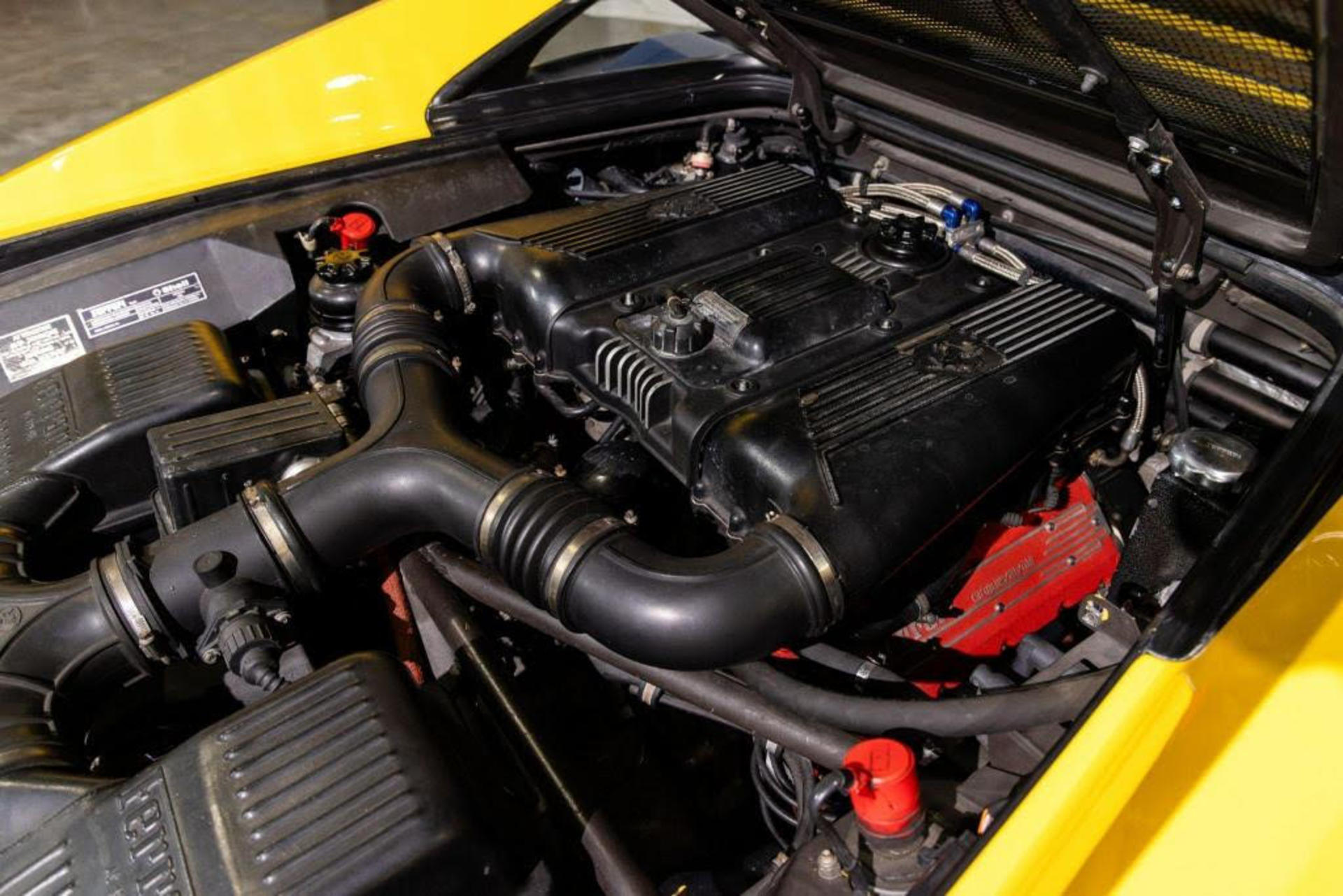
At 80kW/litre, this gave the F355 the highest specific output of any naturally aspirated engine in the world, besting even the mighty McLaren F1. Combined with a new six-speed gearbox and limited-slip diff, Ferrari claimed its new machine could sprint to 100km/h in 4.7sec and complete the quarter mile in 12.9sec on its way to a 293km/h top speed.
An example of Ferrari’s new approach was not just increasing the gear count from five to six, but changing the shift mechanism from cables to rods and adding a heat exchanger, making for a more accurate shift that warmed up much more quickly.
Another groundbreaking innovation was the introduction of an automated manual gearshift, the 355 F1 using the same technology that had first appeared in Ferrari’s single seaters in 1989.
The chassis received an equally thorough makeover as the drivetrain, the body frame lighter but 30 per cent stiffer, wider tracks, electronically adaptive Bilstein dampers, standard power steering and 18-inch magnesium wheels with tyres measuring 225/40 at the front and 265/40 at the rear.
The stiffer body allowed the springs to be softened for vastly improved ride comfort, yet stiffer anti-roll bars provided sharper, more consistent and more progressive handling, the clever new dampers adjusting themselves to suit as required.
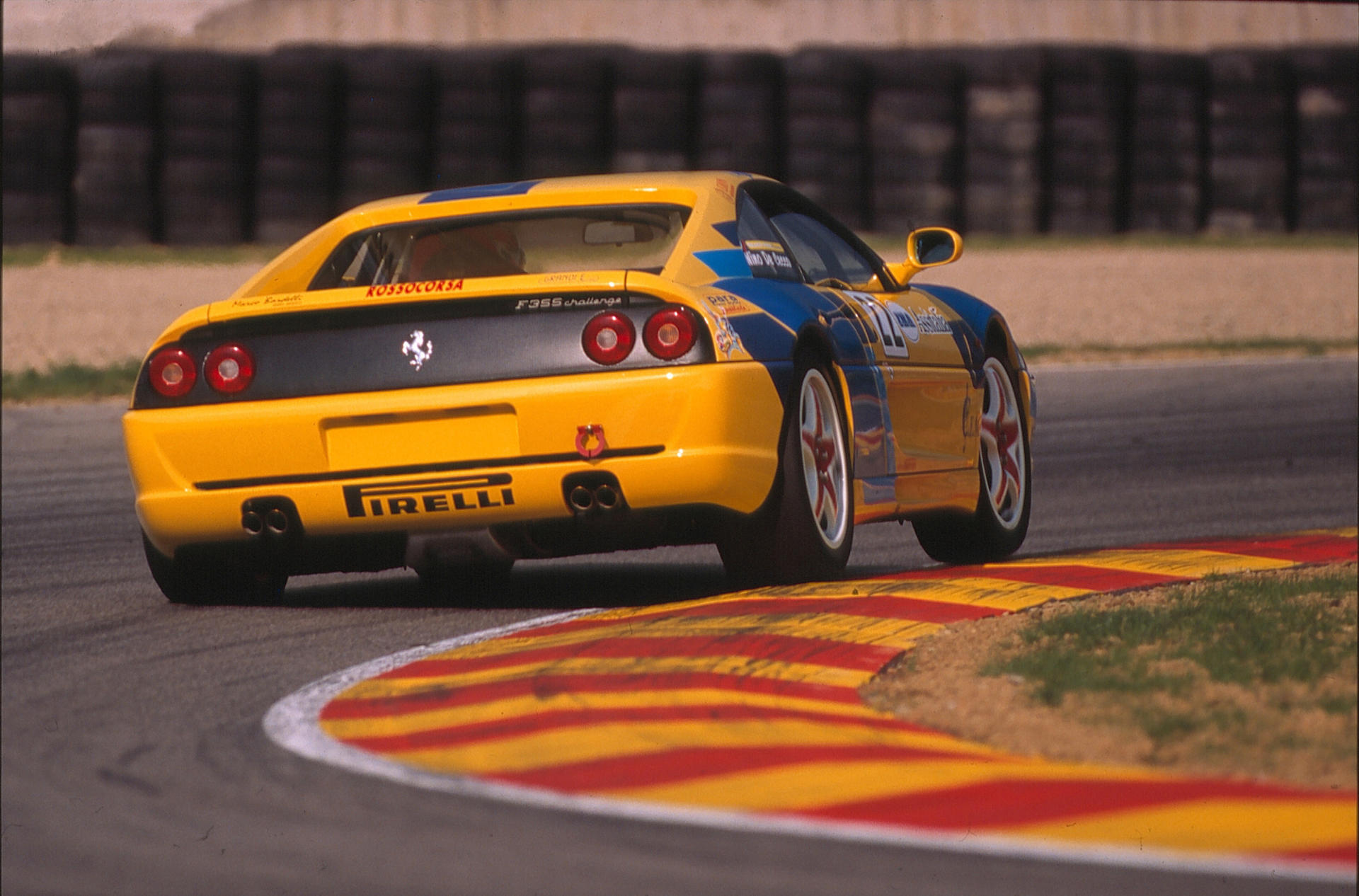
A Fiorano Handling Pack, inspired by the Challenge one-make race car that was introduced in 1995, was made available comprising quicker steering, a lower ride height, bespoke suspension ECU, uprated springs, thicker anti-roll bars, wider tracks and upgraded brake pads but fewer than two per cent of cars were fitted with it and fewer than 0.3 per cent of manuals.
Weight increased by about 50kg over the 348 thanks to the power steering, dual exhaust system, six-speed gearbox and adaptive dampers, but Ferrari clawed some back through the lighter body frame, aluminium dampers, lighter engine, magnesium bellhousing and aluminium fuel and coolant tanks.
Customers who were particularly weight-obsessive could also option composite seats to save 14kg aside and forgo the power steering to delete another 10kg.
The motoring media gushed over Ferrari’s new sports car, Jeremy Clarkson declaring it “the greatest car, in the world, ever!” loving it so much he bought one. In Peter Robinson’s first drive for Wheels, he concluded “Isn’t it great that Ferrari has retained all the marque’s titanic character and emotion while making a car far more civilised and controllable, easier to drive quickly and slowly, and to live with daily? A price increase below 10 per cent seems a pittance for such progress.”
Between 1994-1999 11,273 examples of the F355 and 355 F1 (as the manuals and semi-autos were called respectively) were built, 76 per cent of which were manual, and 138 came to Australia.
Prices start at around $200,000, but these will be imported cars. This shouldn’t necessarily discount them, but history may be more difficult to track and a thorough inspection – which is a good idea regardless – should be conducted prior to purchase.
Clean Australian cars require around $300,000 and there isn’t a huge different in value between the body styles and gearboxes. The collector’s choice would be an early (pre-1996) manual coupe as while the later Motronic 5.2 ECU reduced emissions and smoothed out the engine, the early cars are a bit livelier by all accounts.
Almost a third of all F355/355 F1s sold were bought in 1999, its final year of production, so this will explain if you see a disproportionately large number of this year pop up.
Be aware that these are not cheap cars to maintain. The major issues are likely to have been addressed now 30 years later, including rust where the rear wing meets the buttress on the Berlinetta and GTS, cracking exhaust manifolds (thicker aftermarket replacements are the cure) and worn valve guides.
Some cars may have had leather interior surfaces replaced with Alcantara as the former has a tendency to shrink in hot weather and crack; the thermoplastic covering on the switchgear also degrades and goes sticky over time, a common Ferrari trait.
Regardless, even minor annual servicing will be in the thousands and every three years the engine’s belts need servicing. It can apparently be done without dropping the subframe, but the latter makes life a lot easier and allows any other potential issues to be attended to at the same time. Budget at least $10,000.
However, the Ferrari F355 is a car that wasn’t just a standout of its era, stylistically and mechanically, but is historically significant, being primarily responsible for restoring the brand’s reputation and turning its financial fortunes around.